
DIRECT ANSWER
The cost to remove a 1000-ton industrial chiller typically ranges from tens of thousands to over a hundred thousand dollars, though no single price applies universally due to the vast differences in facility conditions. The final expense is driven by the complexity of the extraction path, the type and volume of refrigerant that must be recovered, and the heavy rigging required to move equipment of this scale. A straightforward ground-level removal with clear access will cost significantly less than extracting a unit from a high-rise mechanical room or a sub-basement requiring specialized cranes and structural modifications. Additionally, the presence of hazardous materials, the need for temporary cooling during the transition, and the logistical challenges of transporting oversized loads over public roads all add to the baseline costs. Facility managers must also account for potential offset values if the chiller or its components hold salvage or resale value, which can reduce the net financial impact of the project.
Logistics and Site Access Challenges
The physical location of the 1000-ton chiller within the facility is the most significant variable in determining removal costs. Chillers situated in easily accessible ground-floor mechanical rooms with wide bay doors allow for straightforward extraction using standard forklifts and flatbed trailers. In contrast, units located in basements, penthouses, or tight mechanical spaces often require partial or complete disassembly before they can be moved. Disassembling a massive centrifugal or absorption chiller into manageable sections drastically increases labor hours and the need for specialized cutting and handling equipment.
Furthermore, the extraction path must be carefully evaluated to ensure floors, freight elevators, and doorways can support the weight and dimensions of the equipment. Facility managers frequently need to temporarily remove doors, knock down non-load-bearing walls, or reinforce flooring to accommodate the heavy machinery moving through the building. Every obstacle in the extraction path translates directly into increased project time and higher overall costs for the removal operation.
Refrigerant Recovery and Environmental Compliance
Before any mechanical dismantling can begin, all refrigerant and lubricating oils must be safely recovered from the 1000-ton chiller. The cost of this phase is dictated by the type of refrigerant, the total volume in the system, and the current market rates for recovery and disposal. Older systems utilizing phased-out refrigerants may incur higher handling fees, while the recovery of high-value refrigerants might offer a slight cost offset. The process requires certified technicians and specialized recovery equipment capable of handling large volumes efficiently without risking atmospheric venting.
Environmental compliance extends beyond just the refrigerant. Industrial chillers of this size often contain hundreds of gallons of oil that must be drained, tested, and disposed of according to local and federal environmental regulations. If the system has experienced a catastrophic failure, such as a motor burnout, the oil and refrigerant may be heavily contaminated with acids and particulates, necessitating more complex and expensive purification or disposal methods. Strict adherence to these protocols is mandatory, and cutting corners can lead to severe regulatory fines that dwarf the initial removal estimates.
Heavy Rigging and Structural Modifications
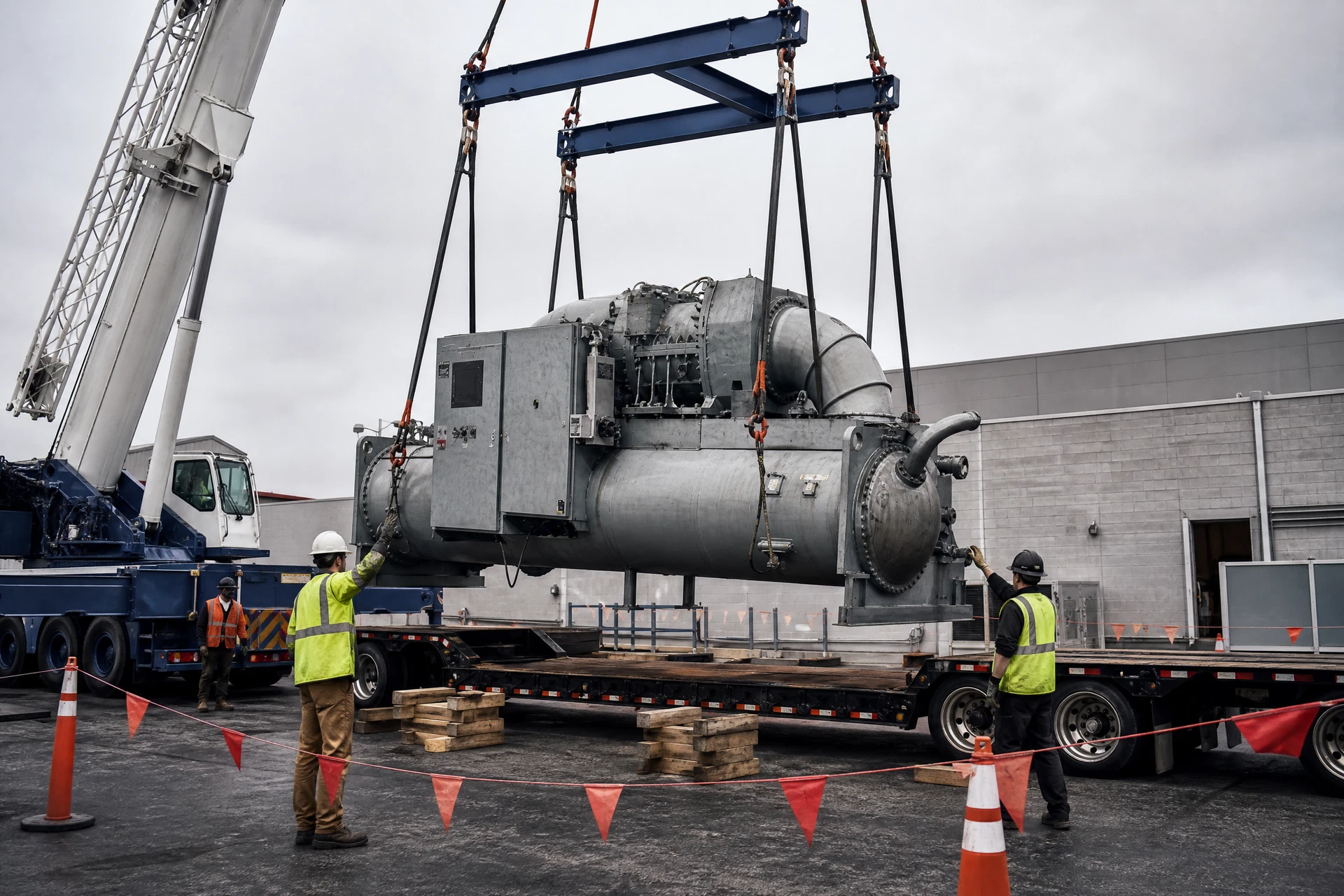
Moving a piece of equipment that weighs tens of thousands of pounds requires heavy rigging expertise and specialized lifting apparatus. For chillers located on rooftops or upper floors, the deployment of large-capacity mobile cranes or even helicopters may be necessary. Crane mobilization alone can add thousands of dollars to the project, particularly in dense urban environments where street closures, traffic control permits, and police details are required. The rigging team must engineer a lift plan that accounts for the chiller's center of gravity, wind loads, and the structural integrity of the building.
In some scenarios, the building's structure itself must be temporarily altered to allow for the chiller's extraction. This can involve removing sections of the roof, cutting through exterior walls, or reinforcing structural beams to support the load of the rigging equipment. These architectural modifications require the involvement of structural engineers and specialty contractors, further compounding the total cost. The coordination between the rigging crew, structural engineers, and facility management is critical to ensuring the safe and efficient removal of the equipment without damaging the host building.
Salvage Value and Equipment Resale
While the removal of a 1000-ton chiller is inherently a major expense, the potential salvage or resale value of the equipment can provide a financial offset. If the chiller is relatively new, well-maintained, and features modern, energy-efficient technology, it may be sold on the secondary market to equipment brokers or other facilities. In these cases, the removal process must be executed with extreme care to preserve the integrity of the unit, which can increase the upfront removal costs but result in a net financial gain once the equipment is sold.
Conversely, if the chiller is at the end of its operational lifespan or has suffered irreparable damage, its value is typically limited to scrap metal. A 1000-ton unit contains significant amounts of copper, aluminum, and steel, which can be sold to recycling facilities. The scrap value fluctuates with global commodities markets and is usually factored into the contractor's initial bid. However, facility owners should be aware that the labor costs required to cut, separate, and transport the materials often consume a large portion of the gross scrap value, making it a modest offset rather than a lucrative windfall.
Decision table
Questions that change the plan.
Is the chiller located in a basement, penthouse, or ground floor?
Difficult access requires disassembly or specialized cranes, increasing costs.
Does the system use a phased-out or current generation refrigerant?
Older refrigerants may incur higher disposal fees, while modern ones might offer recovery value.
Is the chiller functional and eligible for resale, or is it scrap?
Preserving a unit for resale requires careful, slower extraction compared to destructive scrapping.
Will walls, doors, or roofs need to be temporarily removed?
Architectural modifications add engineering, demolition, and reconstruction expenses.
Field checklist
Prepare the record before the work.
- 01
Confirm the physical dimensions and weight of the chiller against all egress pathways
- 02
Audit the current volume and type of refrigerant for recovery planning
- 03
Verify that the electrical disconnects have been properly locked out and tagged out
- 04
Assess the need for temporary cooling solutions during the transition period
- 05
Secure necessary permits for crane operation and street closures if applicable
- 06
Evaluate the structural capacity of floors and roofs along the extraction route
Common questions
Before the next step.
How long does it take to remove a 1000-ton chiller?+
The timeline varies from a few days for straightforward ground-level removals to several weeks for complex extractions requiring disassembly and structural modifications.
Can the cost of removal be offset by selling the chiller?+
Yes, if the chiller is operational and modern, it may have resale value. Otherwise, the copper and steel can be sold for scrap, though labor costs often absorb much of this value.
Do I need to hire a separate contractor for refrigerant recovery?+
Many industrial HVAC contractors handle both recovery and removal, but specialized environmental firms are sometimes required for highly contaminated systems.
Are permits required for chiller removal?+
Permits are typically required, especially if the removal involves crane lifts, street closures, structural changes, or handling of hazardous materials.