
DIRECT ANSWER
Older industrial chillers commonly utilize chlorofluorocarbons (CFCs) like R-11 and R-12, or hydrochlorofluorocarbons (HCFCs) such as R-22 and R-123. The specific refrigerant depends heavily on the chiller's manufacturing era and compressor type. Centrifugal chillers built before the mid-1990s frequently operated on low-pressure R-11 or high-pressure R-12, while later models transitioned to R-123 or R-134a. Reciprocating and scroll chillers from similar periods predominantly used R-22 until its phaseout restricted availability. Understanding exactly what refrigerant is inside an aging chiller dictates maintenance costs, leak repair protocols, and the complexity of eventual asset recovery. Because these legacy gases carry significant environmental regulations, identifying the charge is critical before attempting any service or removal. Note that this information serves as a general guide; verifying the actual contents requires physical inspection of the equipment data plate and testing by certified technicians, as systems may have been retrofitted during their operational lifespan.
Identifying Legacy CFCs in Early Centrifugal Systems
Centrifugal chillers manufactured prior to 1995 were primarily designed around chlorofluorocarbon (CFC) refrigerants, most notably R-11 and R-12. R-11 was the standard for large-tonnage, low-pressure centrifugal machines due to its excellent thermodynamic properties and operating efficiency. Because R-11 operates at a negative pressure (a vacuum) under normal ambient conditions, these chillers require purge units to remove non-condensable gases and moisture that leak into the system. If you are evaluating a vintage centrifugal chiller with a purge unit, it is highly probable that it was originally charged with R-11, unless a retrofit was performed.
High-pressure R-12 was also utilized in certain centrifugal applications, though less commonly than R-11, as well as in some older reciprocating systems. The production of both R-11 and R-12 was halted in developed countries by 1996 under the Montreal Protocol due to their high ozone depletion potential (ODP). Consequently, any chiller still operating on these refrigerants relies entirely on reclaimed stockpiles. The scarcity of these legacy CFCs has driven up maintenance costs significantly, making the identification of these gases a primary driver for equipment replacement or decommissioning decisions.
The Prevalence of R-22 in Reciprocating and Scroll Chillers
For decades, R-22 (a hydrochlorofluorocarbon or HCFC) was the workhorse refrigerant for small to medium-tonnage industrial chillers utilizing reciprocating, scroll, and screw compressors. Its versatility and efficiency made it the default choice for air-cooled and water-cooled systems across countless manufacturing facilities and commercial plants. Chillers built between the 1970s and the late 2000s are very likely to contain R-22, provided they have not been retrofitted with drop-in replacements.
The phaseout of R-22 began later than the CFCs, with a complete ban on new production and import taking effect in the United States in 2020. While R-22 chillers can legally continue to operate, servicing them requires sourcing reclaimed refrigerant, which fluctuates in price and availability. Facility managers evaluating older R-22 equipment must weigh the cost of topping off a leaking system against the capital expense of upgrading to modern, HFC or HFO-based equipment. When decommissioning an R-22 chiller, the recovered refrigerant still holds value, but it must be handled by certified professionals to ensure compliance with environmental regulations.
Transitional Refrigerants: R-123 and Early R-134a Systems
As the industry moved away from CFCs in the 1990s, manufacturers introduced transitional refrigerants to bridge the gap. R-123, an HCFC, was developed as a direct replacement for R-11 in low-pressure centrifugal chillers. Many older R-11 chillers were retrofitted to use R-123, and new machines were designed specifically for it. While R-123 has a significantly lower ODP than R-11, it is still an HCFC and is subject to its own phaseout schedule, with new equipment production halted in 2020. Identifying an R-123 chiller often involves checking for a purge unit, similar to R-11 systems, but the data plate will confirm the specific charge.
Simultaneously, R-134a (an HFC) emerged as the primary zero-ODP replacement for R-12 and eventually became a standard for many centrifugal, screw, and scroll chillers. Chillers manufactured from the late 1990s through the 2010s frequently utilize R-134a. While R-134a does not deplete the ozone layer, it has a high global warming potential (GWP), which has led to its inclusion in more recent phasedown regulations like the AIM Act. Therefore, even chillers utilizing these "newer" transitional refrigerants are now facing regulatory pressures, making accurate identification essential for long-term facility planning.
Verifying the Refrigerant Charge and Retrofit History
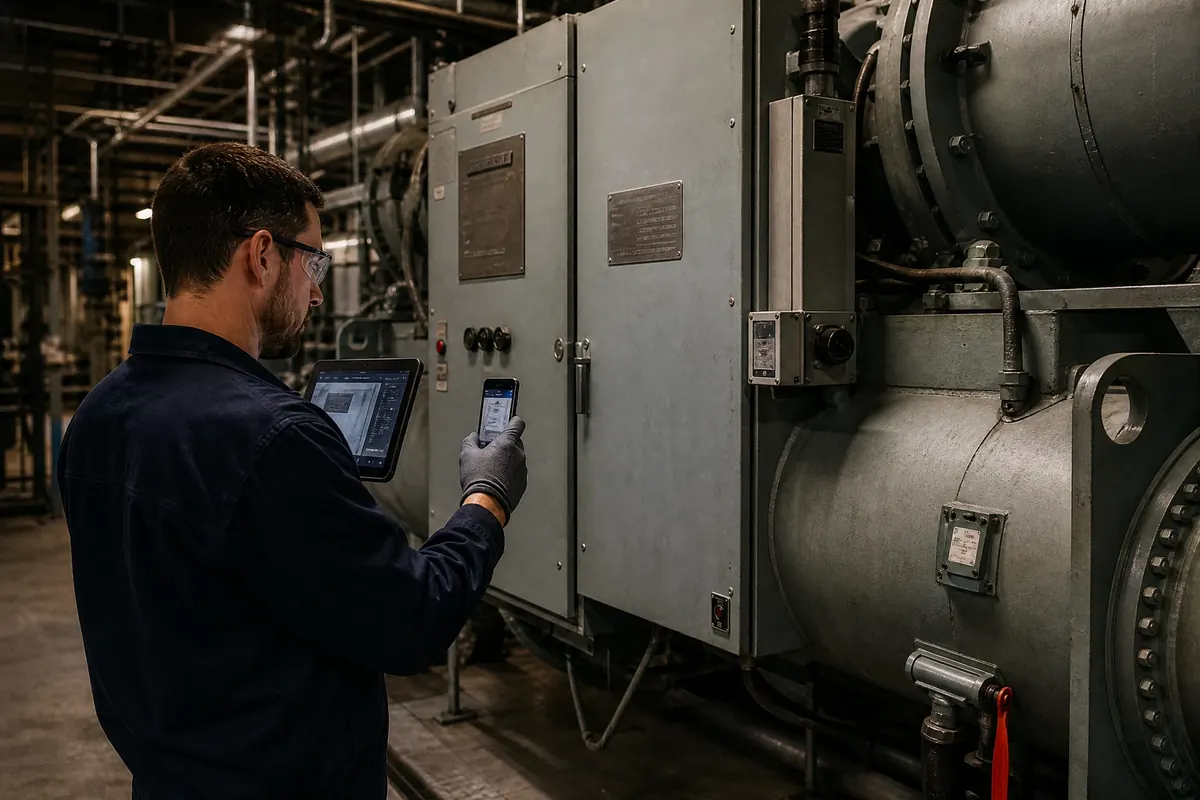
Determining the exact refrigerant in an older chiller cannot rely solely on the equipment's age or compressor type. The most reliable method of identification is locating the manufacturer's data plate, typically riveted or adhered to the chiller's control panel or main structural frame. This plate lists the factory-designated refrigerant type and the total charge weight. However, because industrial chillers have lifespans exceeding 20 to 30 years, many have undergone significant modifications, including refrigerant retrofits, during their operational history.
If a chiller was retrofitted (for example, from R-11 to R-123, or from R-22 to an HFC blend like R-407C), the servicing contractor should have affixed a new label detailing the updated refrigerant type, the date of the conversion, and the type of lubricating oil used (such as POE or mineral oil). If the data plate is illegible or missing, or if there is conflicting labeling, a certified HVAC technician must extract a sample of the refrigerant and test it using a refrigerant analyzer. Guessing the refrigerant type can lead to catastrophic compressor failure if the wrong gas or oil is introduced, or severe legal penalties if handled improperly during decommissioning.
Decision table
Questions that change the plan.
Was the chiller built before 1995?
High probability of legacy CFCs (R-11, R-12) or early HCFCs (R-22) requiring specialized recovery.
Does the system use a low-pressure centrifugal compressor?
System likely utilizes R-11 or R-123 and requires a purge unit for operation.
Are there secondary labels indicating a refrigerant change?
The original data plate is no longer accurate; the system must be handled based on the retrofit label.
Is the identified refrigerant subject to an active phaseout?
Maintenance costs will increase as reclaimed gas becomes scarce, accelerating the need for replacement.
Field checklist
Prepare the record before the work.
- 01
Locate and clean the original manufacturer data plate to read the factory refrigerant specification
- 02
Search the chiller control panel and compressor housings for aftermarket retrofit labels
- 03
Check the compressor oil type, as specific refrigerants require compatible lubricants (e.g., POE vs. mineral oil)
- 04
Identify the presence of a purge unit, which typically indicates a low-pressure refrigerant like R-11 or R-123
- 05
Review facility maintenance logs and service invoices for records of refrigerant additions or conversions
- 06
Engage a certified technician to perform a chemical analysis if the refrigerant type remains uncertain
Common questions
Before the next step.
Can I mix a new refrigerant into an older chiller to replace a phased-out gas?+
No. Mixing different refrigerants alters the pressure-temperature relationship and can cause severe compressor damage. Any retrofit requires recovering the old gas, changing the oil, and following strict engineering guidelines.
How do I know if my older chiller uses R-11 or R-123?+
Both are low-pressure refrigerants used in centrifugal chillers. The primary way to distinguish them is by checking the manufacturer's data plate or any retrofit labels applied by service contractors.
Is it illegal to operate a chiller that uses R-22?+
It is not illegal to operate an existing R-22 chiller. However, the production and import of new R-22 are banned, meaning any necessary repairs requiring additional gas must rely on limited reclaimed supplies.
What happens to the old refrigerant when a chiller is decommissioned?+
The refrigerant must be safely recovered by EPA-certified technicians using specialized equipment. It is then sent to a reclamation facility to be cleaned and resold, or safely destroyed if heavily contaminated.