
DIRECT ANSWER
The resale value of air-cooled versus water-cooled chillers is primarily dictated by market liquidity, installation complexity, and capacity ranges rather than strictly age or initial capital cost. Air-cooled chillers generally exhibit higher liquidity and faster turnover on the secondary market because they operate independently of a cooling tower infrastructure, making them attractive for emergency replacements, temporary cooling, or facilities with limited mechanical footprints. Consequently, late-model air-cooled units often retain a higher percentage of their original value in the short term. Conversely, water-cooled chillers are heavily dependent on existing site infrastructure and are typically specified for permanent, large-scale industrial or commercial applications. While their buyer pool is smaller and transactions take longer, well-maintained, high-tonnage water-cooled centrifugal or screw chillers can hold substantial absolute value, provided their compressor and heat exchanger conditions are documented. Ultimately, resale value for either configuration hinges heavily on documented maintenance history, refrigerant type, and operational hours.
Market Liquidity and Buyer Demand
The secondary market for industrial chillers operates on the principles of immediate need and installation feasibility. Air-cooled chillers inherently possess a broader buyer base because they are packaged systems requiring only electrical power and chilled water connections. This self-contained nature allows them to be deployed rapidly for emergency cooling, seasonal capacity increases, or in facilities where water scarcity or space constraints prohibit cooling towers. Because more facilities can accommodate an air-cooled unit without significant infrastructure modifications, the demand remains consistently high, translating to competitive resale pricing and shorter time-on-market for sellers.
In contrast, water-cooled chillers are intrinsically linked to a facility's condenser water loop, requiring cooling towers, condenser pumps, and specialized water treatment systems. Buyers seeking used water-cooled chillers are typically executing planned retrofits or replacing an existing unit of similar capacity and footprint. The necessity for the used chiller to match the buyer's existing infrastructure narrows the potential market. However, for large-tonnage applications—often exceeding 500 tons—water-cooled systems are the standard. When a buyer requires a high-capacity replacement, a well-documented water-cooled chiller becomes a highly valuable asset, even if the search for the right buyer takes longer.
Depreciation Curves and Lifespan Factors
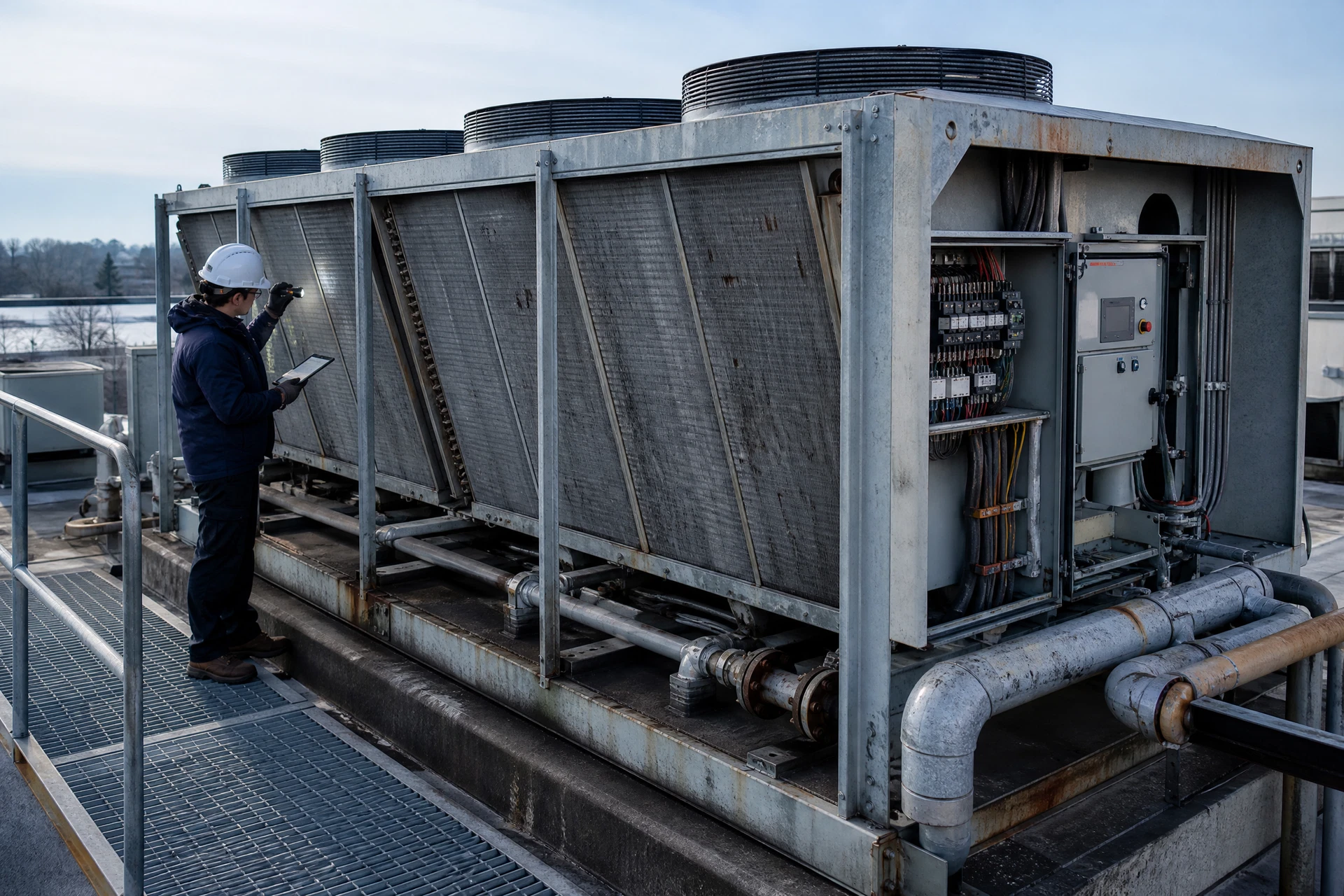
Depreciation curves differ notably between the two chiller types due to their operating environments and design lifespans. Air-cooled chillers are typically installed outdoors, exposing their coils, fans, and electrical panels to ambient weather conditions, UV radiation, and potentially corrosive atmospheres. This exposure accelerates physical degradation, meaning air-cooled units generally have a shorter operational lifespan (often 15 to 20 years) compared to indoor units. Consequently, their depreciation curve is steeper in the later years of their life, and resale value drops sharply once the unit exceeds a decade of continuous service, particularly if the condenser coils show signs of significant corrosion or fin damage.
Water-cooled chillers, housed within protected mechanical rooms, are shielded from weather extremes. With proper maintenance, particularly rigorous water treatment to prevent scaling and tube degradation, water-cooled centrifugal and screw chillers can operate reliably for 25 to 30 years or more. Because of this extended lifespan, a 10-year-old water-cooled chiller may still be considered relatively young in its lifecycle, retaining a significant portion of its mechanical viability. Buyers are often willing to invest in older water-cooled units if the eddy current tests on the evaporator and condenser tubes return clean results, stabilizing the unit's long-term resale value.
The Impact of Refrigerant Phase-Outs
Refrigerant regulations heavily influence the secondary market value of all cooling equipment. As environmental regulations phase down high-Global Warming Potential (GWP) refrigerants, chillers utilizing older gases face steep devaluation. Air-cooled and water-cooled units running on legacy refrigerants like R-22 have virtually no resale value beyond scrap, while those using transitional refrigerants like R-134a or R-410A are beginning to see their values impacted by the shift toward next-generation alternatives such as R-513A, R-1234ze, or R-32.
When evaluating resale potential, the ability to retrofit a chiller to a newer, compliant refrigerant can preserve its value. However, retrofitting is often more economically viable on large water-cooled centrifugal machines than on smaller air-cooled scroll or screw chillers. Buyers of used equipment are increasingly scrutinizing the refrigerant type, knowing that future scarcity will drive up maintenance costs. A late-model chiller, regardless of its cooling method, that utilizes a modern, low-GWP refrigerant will command a premium and sell significantly faster than an equivalent unit tied to a phased-out gas.
Logistics, Rigging, and Relocation Costs
The cost of removing, transporting, and reinstalling a chiller directly impacts the net return for the seller and the final cost for the buyer. Air-cooled chillers, while bulky, are typically located on roofs or ground-level pads. Removing them usually involves a straightforward crane lift and loading onto a flatbed trailer. Because the rigging is relatively uncomplicated, the logistical costs do not severely depress the unit's underlying value. Buyers can accurately estimate freight and installation, making the transaction smoother.
Conversely, water-cooled chillers are often situated deep within mechanical rooms, sometimes requiring partial disassembly, wall removal, or complex interior rigging to extract. These high extraction costs can significantly erode the net resale value for the seller, as buyers will factor the expensive removal and relocation logistics into their offers. In some cases, the cost to extract a large water-cooled unit from a challenging location may exceed the equipment's secondary market value, rendering it a liability rather than an asset.
Decision table
Questions that change the plan.
How quickly can the unit be sold to a waiting buyer?
Air-cooled units typically sell faster due to broader compatibility, while water-cooled units wait for specific infrastructure matches.
Has the unit been subjected to harsh outdoor conditions?
Outdoor air-cooled units depreciate faster from weather exposure; indoor water-cooled units retain mechanical integrity longer.
What is required to extract the chiller from its current location?
High extraction costs for basement or deep mechanical room water-cooled units can severely reduce the seller's net return.
What percentage of the unit's design life has been consumed?
A 15-year-old water-cooled unit retains more viable life than a 15-year-old air-cooled unit, supporting higher residual value.
Field checklist
Prepare the record before the work.
- 01
Review recent eddy current test reports for water-cooled condenser and evaporator tubes
- 02
Inspect air-cooled condenser coils for fin degradation, hail damage, or galvanic corrosion
- 03
Verify the current refrigerant type and its status under local environmental phase-down regulations
- 04
Compile a complete maintenance log detailing compressor overhauls, oil analyses, and control board replacements
- 05
Assess the extraction path from the mechanical room or roof to determine rigging and crane requirements
- 06
Confirm the operational hours and start/stop cycles logged on the chiller's control panel
Common questions
Before the next step.
Does a water-cooled chiller always have a higher resale value than an air-cooled chiller?+
Not necessarily. While large-tonnage water-cooled chillers have higher initial costs and can retain significant absolute value, air-cooled chillers often hold a higher percentage of their original value in the short term due to higher market demand and easier installation.
How much does the refrigerant type affect the resale price?+
Refrigerant type is a major pricing factor. Chillers using phased-out or high-GWP refrigerants suffer severe depreciation, whereas units utilizing modern, low-GWP refrigerants command premium prices on the secondary market.
Why is maintenance documentation so critical for selling a used chiller?+
Used equipment buyers inherit the operational risk of the machine. Comprehensive logs, oil analysis reports, and eddy current tests provide proof of condition, mitigating buyer risk and justifying a higher purchase price.
Do extraction costs reduce what a buyer will pay for my chiller?+
Yes. Buyers calculate the total landed cost, which includes purchasing, rigging, freight, and installation. If a water-cooled chiller is difficult and expensive to remove from your facility, the buyer will lower their offer to compensate for those high logistical costs.