
DIRECT ANSWER
Planning an industrial chiller decommissioning requires a sequential approach focused on risk mitigation, regulatory compliance, and logistical coordination. The process begins with a comprehensive site assessment to identify structural constraints, electrical configurations, and the specific requirements for refrigerant recovery. Facility managers must engage certified technicians to safely recover and document all refrigerants and lubricants before any physical dismantling occurs. Following fluid removal, licensed electricians must verify the complete isolation and lockout/tagout of all power sources. Rigging and lifting operations then require specialized heavy-duty equipment and engineered lift plans tailored to the facility's architecture. It is critical to recognize that this article provides a general framework, not an engineering or safety manual. Every facility presents unique challenges, meaning that all environmental, structural, and electrical work must be performed by qualified professionals in accordance with local regulations and site-specific conditions. Proper planning minimizes operational disruption and prevents costly safety incidents during the removal process.
Site Assessment and Logistical Preparation
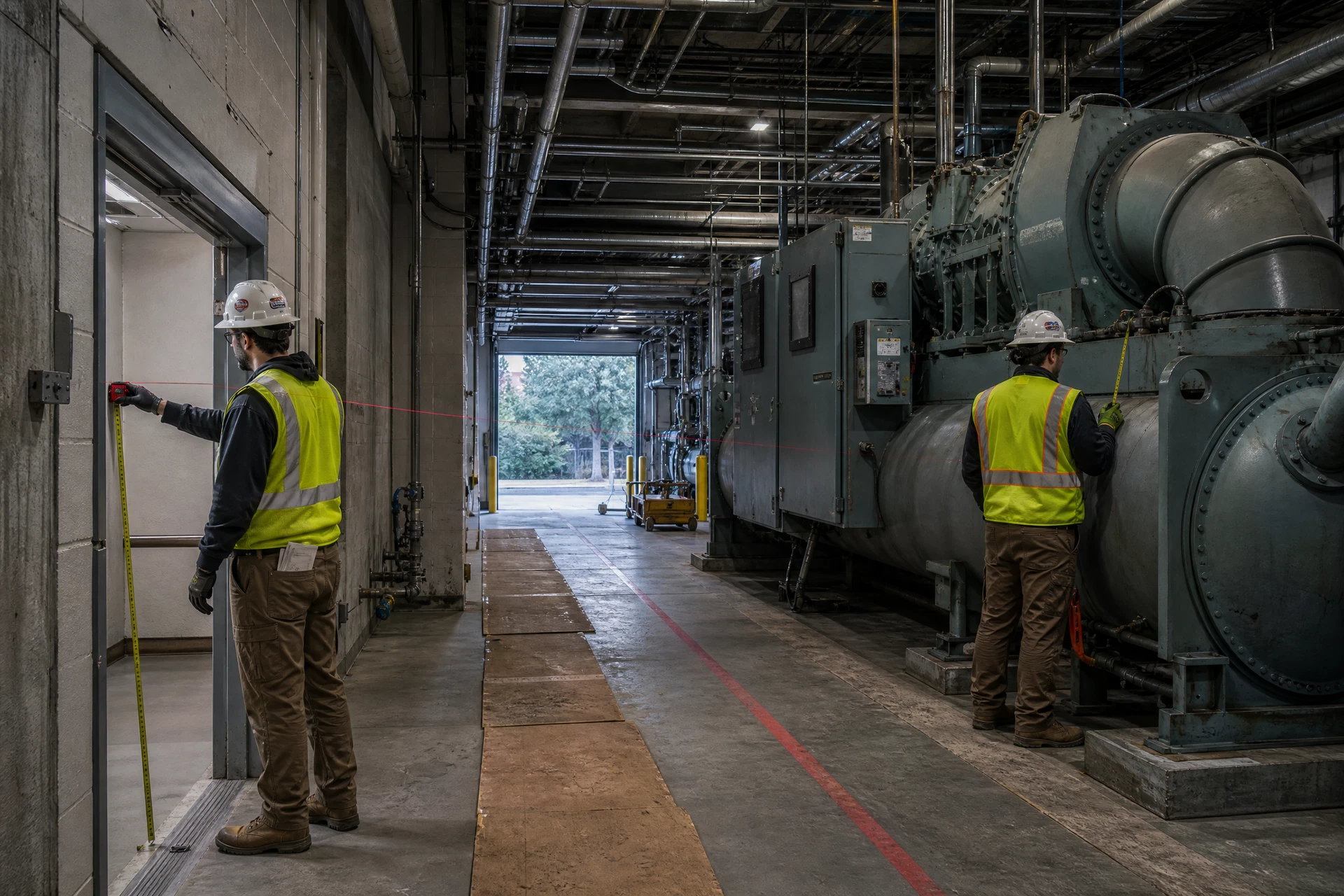
The foundation of a successful chiller decommissioning is a thorough site assessment. Project teams must evaluate the physical environment to determine the most viable egress route for the equipment. This involves measuring doorways, checking the load-bearing capacity of floors, and identifying overhead obstructions that could interfere with rigging equipment. Detailed structural analysis is often required to ensure the building can support the heavy machinery needed for extraction.
In addition to physical constraints, the assessment must account for the operational impact on the facility. Temporary cooling solutions may be required if the facility must maintain temperature control during the transition. Establishing a clear timeline and coordinating with all stakeholders ensures that the decommissioning process aligns with production schedules and minimizes downtime. Effective communication between facility managers, contractors, and production staff is vital for a seamless operation.
Refrigerant and Fluid Recovery Procedures
Before any mechanical disassembly begins, all refrigerants, oils, and secondary fluids must be safely evacuated from the chiller system. This phase must be executed by EPA-certified technicians using specialized recovery equipment designed to prevent environmental contamination. The recovered fluids must be weighed, documented, and transported to approved recycling or disposal facilities in compliance with stringent environmental regulations. Proper handling of these substances is non-negotiable.
Failure to properly manage refrigerants can result in severe legal penalties and environmental damage. The recovery process also includes purging the system with nitrogen to ensure no residual hazardous gases remain. Comprehensive documentation of this phase is essential for regulatory audits and demonstrating environmental accountability. Facilities must retain all manifests and certificates of destruction or recycling to prove compliance with federal and local mandates.
Electrical and Mechanical Disconnection
Once the system is verified empty and safe, the focus shifts to electrical and mechanical isolation. Licensed electricians must execute strict lockout/tagout (LOTO) procedures to secure all power sources connected to the chiller. This includes disconnecting main power feeds, control wiring, and any integrated communication networks. Verifying zero energy state is a critical safety checkpoint before any cutting or unbolting occurs.
Following electrical isolation, mechanical contractors can begin severing the physical connections. Chilled water lines, condenser water piping, and pneumatic controls must be capped and secured. Depending on the size of the unit and the constraints of the facility, the chiller may need to be dismantled into manageable sections to facilitate safe removal through the established egress routes. This requires precise cutting and disassembly techniques to avoid damaging the surrounding infrastructure.
Rigging, Lifting, and Transportation
The final phase involves the physical extraction of the chiller using specialized rigging and lifting techniques. Heavy machinery such as gantries, forklifts, or cranes are typically required to maneuver the equipment safely. An engineered lift plan is crucial to ensure that the weight distribution is managed correctly and that the structural integrity of the building is not compromised during the move. Riggers must account for the shifting center of gravity as the equipment is lifted and transported.
Transportation from the facility requires coordination with heavy-haul logistics providers. The equipment must be properly secured on flatbed trailers or specialized transport vehicles. Route planning must account for the dimensions and weight of the load, ensuring compliance with local transportation regulations and securing any necessary permits for oversized cargo. A well-executed transport plan guarantees the equipment reaches its final destination without incident.
Decision table
Questions that change the plan.
Does the system use regulated or phased-out refrigerants?
Requires specialized recovery equipment and stringent documentation for disposal.
Are there narrow corridors, low ceilings, or weight-restricted floors?
May necessitate dismantling the chiller into smaller sections before removal.
Is the chiller integrated with complex facility control systems?
Demands careful isolation to prevent disrupting other critical building operations.
Does the lift require crane access or specialized gantry systems?
Dictates the type of heavy machinery needed and potential structural reinforcements.
Field checklist
Prepare the record before the work.
- 01
Verify all lockout/tagout (LOTO) procedures are implemented by licensed electricians
- 02
Confirm EPA-certified technicians are scheduled for refrigerant and oil recovery
- 03
Measure all egress routes, doorways, and corridors for clearance
- 04
Review and approve the engineered lift plan with the rigging contractor
- 05
Secure all necessary local permits for heavy equipment transport
- 06
Establish temporary cooling solutions if facility operations must continue
Common questions
Before the next step.
How long does it typically take to decommission an industrial chiller?+
The timeline varies significantly based on the chiller's size, location, and the complexity of the fluid recovery process, but most projects take between several days and a few weeks.
Who is responsible for handling the recovered refrigerant?+
Only EPA-certified technicians are legally permitted to recover, transport, and dispose of or recycle industrial refrigerants.
Can a decommissioned chiller be sold for reuse?+
Yes, if the unit is well-maintained and carefully removed without damage, it can often be sold on the secondary market or refurbished.
Do I need special permits for chiller removal?+
Permit requirements depend on local jurisdictions and may include environmental approvals for fluid disposal, building permits for structural work, and transport permits for oversized loads.